| cmd | ||
| misc | ||
| repo | ||
| src | ||
| CHANGELOG.md | ||
| clean | ||
| go.mod | ||
| go.sum | ||
| LICENSE | ||
| README.md | ||

Kaya







Introduction
Kaya is an early-stage implementation of a fully end-to-end encrypted IPv6 mesh network.
It is lightweight, self-arranging, multi-platform, and allows any IPv6-capable application to communicate securely with other Kaya nodes. Kaya does not require native IPv6 Internet connectivity --- it works over IPv4.
This repository extends the baseline implementation with substantial enhancements focused on:
- Performance
- Operability
- Observability
- Runtime safety
- Operator UX
The core protocol semantics are preserved while improving deployment, diagnostics, and control behavior.
Supported Platforms
Kaya runs on:
- Linux
- macOS
- Windows
- FreeBSD
- OpenBSD
- OpenWrt
- Ubiquiti EdgeRouter
- VyOS
Building
Requires Go 1.22 or later.
Build the binaries directly:
go build -o kaya ./cmd/yggdrasil
go build -o kayactl ./cmd/yggdrasilctl
Cross-compiling example:
GOOS=windows GOARCH=amd64 go build -o kaya.exe ./cmd/yggdrasil
Running
Generate Configuration
HJSON:
./kaya -genconf > /path/to/kaya.conf
JSON:
./kaya -genconf -json > /path/to/kaya.conf
Edit the configuration file to add/remove peers, adjust listen addresses, multicast settings, etc.
Start Kaya
With configuration:
./kaya -useconffile /path/to/kaya.conf
Auto-configuration mode:
./kaya -autoconf
Kaya requires permission to create TUN/TAP adapters. On Linux, run under
sudo or grant the binary CAP_NET_ADMIN.
Extended Features in This Repository
This repository includes a substantial set of enhancements on top of baseline behavior.
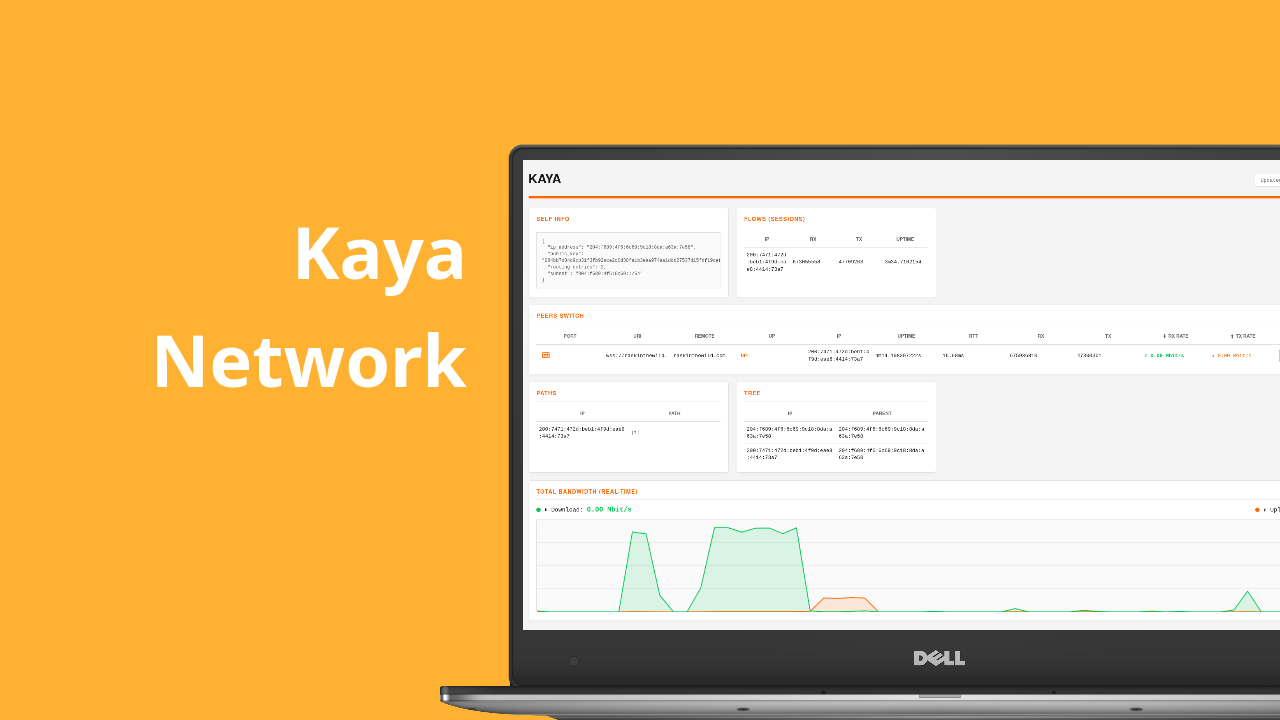
1) Operator Dashboard (Built-in HTTP UI)
A built-in web dashboard is available directly from the daemon to monitor and manage node state.
Live runtime telemetry for:
- node/self identity and routing metadata
- peer links and per-peer health
- session/flow activity
- path and tree information
Additional capabilities:
- Peer control actions (disconnect / traffic control via daemon APIs)
- Optional authentication for the private dashboard listener
- Public read-only dashboard mode (
--public-interface) - Real-time bandwidth visualization (Mbit/s) with directional indicators
- Responsive, overflow-safe layout for long URIs and IPv6 addresses
2) Runtime Control and Safety Hardening
Stronger operator controls for CPU behavior and process hardening:
--threadsexplicitly controls scheduler parallelism (GOMAXPROCS)--max-threadsprovides a hard cap for OS threads--sandboxenables Linux hardening early in startup:- no-new-privileges
- non-dumpable process mode
- core-dump suppression
These options provide predictable behavior on constrained systems and hardened production deployments.
3) Colorized, High-Signal Terminal Logging
Interactive stdout logs are rendered with contextual colorization:
- Distinct color classes for errors, warnings, link lifecycle, interface messages, and sandbox events
- Improved per-line TTY rendering
- Faster at-a-glance diagnostics during startup and runtime
4) Admin API Extensions for Traffic Control
Enhanced peer traffic operations:
setPeerTrafficsupport to toggle routing via specific peers- Stricter boolean parsing and validation
- Integrated dashboard and CLI workflows
5) kayactl UX and Topology Visibility Improvements
CLI enhancements include:
- Improved peer listing with direct remote endpoint view
- Clearer hierarchical tree/topology formatting
- Tight integration with peer traffic control operations
6) Core Performance Optimizations
Datapath and control-path improvements without changing protocol semantics:
- Persistent ticker-based link average updates (reduced timer churn)
- Optimized peer snapshot collection
- Faster inbound allowed-key authorization lookup
- Reduced atomic overhead in hot accounting paths
- Debug protocol response lifecycle optimizations
- URI parsing and CLI/control surface improvements
7) Transport and Dialing Efficiency Enhancements
Connection setup improvements:
- Improved TCP source-interface handling with short-lived metadata caching
- Better address selection and dial suitability behavior
- Reduced per-dial overhead in WS/WSS transports
- QUIC dialing and throughput optimizations
- TLS configuration correctness fixes in QUIC paths
8) Process-Model and Platform Tightening
Reliability refinements:
- Stronger single-process behavior expectations
- FreeBSD TUN setup returns direct ioctl failures (no shell fallback)
- Clearer dashboard lifecycle and shutdown handling
Practical Outcome
- Better operator visibility (dashboard + CLI)
- Stronger runtime control (
--threads,--max-threads, sandboxing) - Lower operational overhead
- Improved day-2 debugging and peer management
- Safer and faster default operation
Topics
go golang ipv6 mesh-network p2p overlay-network
encrypted-network distributed-systems quic tcp websocket
linux freebsd openbsd macos windows openwrt
cli dashboard observability performance security
sandbox infrastructure networking systems-programming
License
LGPLv3 with linking exception. See LICENSE for details.